Understanding SMPTE ST 2110
The broadcast industry is operating a significant transition, progressively moving away from baseband video to adopt IP-based video contribution workflows.
Besides the technological challenges it comes with, IP migration also opens the doors to new ways of working, to closer partnerships between different TV production centers, and to innovative economic models.
The move to IP relies on a set of protocols defined by the SMPTE consortium to transport professional media – video, audio, and ancillary data – over managed IP networks.
That ecosystem is named ST 2110 and it includes the following standards:
- ST 2110-10 : System Timing and Definitions
- ST 2110-20 : Uncompressed Active Video
- ST 2110-21 : Traffic Shaping and Delivery Timing for Video
- ST 2110-22 : Constant Bit-Rate Compressed Video
- ST 2110-30 : PCM Digital Audio
- ST 2110-31 : AES3 Transparent Transport
- ST 2110-40 : SMPTE ST 291-1 Ancillary Data
- ST 2110-43 : Transport of Timed Text Markup Language for captions and subtitles
From SDI to IP, a change in paradigm
In SDI systems, video, audio, and metadata are multiplexed into a single signal.
ST 2110 takes a different approach: each type of content is transported as a separate stream, or essence, what represents a fundamental shift from traditional baseband infrastructures toward packet-based systems.
The different essences and streams are synchronized together thanks to timestamps sampled on a common clock shared in the infrastructure thanks to PTP (Precision Time Protocol, as defined in IEEE 1588 and adapted to broadcast needs through SMPTE ST 2059-2).
This separation allows each stream to be routed and processed independently, without affecting the others. This increases flexibility but also introduces new technical challenges.
Besides that, ST 2110 systems often use stream redundancy, typically based on SMPTE ST 2022-7. In this approach, two identical streams are sent over separate network paths, and receivers reconstruct the signal by selecting the first arriving packets, providing seamless protection against packet loss or network failures.
Essence Flows and RTP Transport
ST 2110 relies on standard IP mechanisms, primarily the Real-time Transport Protocol (RTP), to carry media streams.
RTP, as defined in IETF RFC 3550, is a packet-based multimedia streaming solution built on top of UDP.
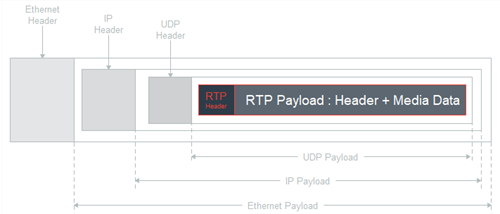
Each essence is packetized into RTP streams with:
- Sequence numbers (to detect packet loss)
- Timestamps (to maintain synchronization)
- Payload formats specific to each media type.
For video, ST 2110-20 defines how pixel data is packetized line-by-line, allowing receivers to reconstruct frames with precise timing. To ensure smooth media playback, ST 2110 systems also implement packet pacing, which controls how packets are sent onto the network so that receivers can process data predictably.
On the other hand, because ST 2110 typically carries uncompressed media, bandwidth requirements are significant. For example, a single 1080p60 stream typically requires 2.5 to 3 Gbps, and a singleUHD (4K60) stream needs approximately 10 Gbps.
This makes network design an essential part of any ST 2110 system engineering, to ensure reliability and deterministic behavior.
The Role of PTP
A key component of ST 2110 is synchronization.
PTP (IEEE 1588 Precision Time Protocol) distributes a highly accurate clock across the network, enabling all devices to operate on a shared time base.
This clock is expressed as an absolute time, referenced to a common starting point called the epoch. All devices align their local clocks to this reference, allowing every media sample or frame to be timestamped consistently across the network.
This approach replaces traditional SDI timing mechanisms:
- Genlock is no longer required: frame alignment is achieved using PTP timestamps
- LTC timecode becomes unnecessary: timing information is derived directly from the shared clock.
As a result, ST 2110 systems rely on a single, unified time base to synchronize video, audio, and data streams, even when they are transported independently.
NMOS
ST 2110 defines how media flows are transported, but it does not specify how devices discover or connect to each other, which is addressed by AMWA NMOS specifications, currently including :
- IS-04 : Discovery & Registration
- IS-05 : Device Connection Management
- IS-07 : Event & Tally
- IS-08 : Audio Channel Mapping
- IS-09 : System Parameters
- IS-10 : Authorization.
The NMOS network traffic, as well as other environmental protocols helping administrate the ST2110 network, can take place either in-band (meaning on the same subnetwork as the actual video content) or out-of-band (meaning on a separate link).
The choice of converged or separated media and control planes is up to the broadcaster.
DELTACAST IP Solutions
ST 2110 systems can be implemented in software or hardware.
Hardware-assisted approaches provide deterministic timing and accurate packet pacing while keeping low CPU load. Software-based approaches offer more flexibility and ease of deployment, as well as an abstraction layer allowing some independency from hardware manufacturers and suppliers.
The DELTACAST strategy is to move forward on both approaches in parallel.
I/O Cards
Initiated with the DELTA-ip-ST2110 10 and DELTA-ip-ST2110 01 10GbE interface cards, the DELTACAST SMPTE ST 2110 products line is now driven forward by its 25GbE solutions:
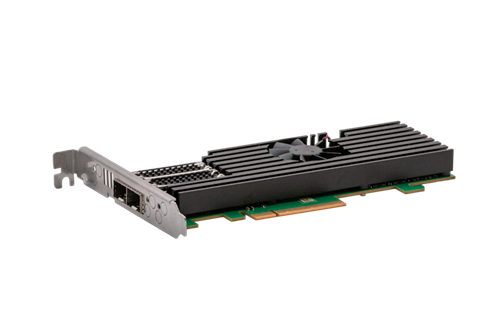
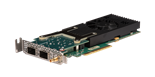
DELTA-IP25-44-elp is a compact, dual-port, I/O board for 25GbE SMPTE ST 2110 networks, providing zero-CPU hardware embedding and deembedding of video, audio and metadata content in IP streams.
Hosting a pair of SFP+ cages intended to SMPTE ST 2022-7 redundancy, DELTA-IP25-44-elp allows simultaneous handling of up to 4 incoming streams and 4 playout streams including video, audio and ancillary data essences. In UHD, the 25G link bandwidth allows up to 2 simultaneous RX and 2 simultaneous TX at up to 2160p60.
DELTA-IP25-44-elp includes hardware PTP handling as well as in-band and out-of-band NMOS support for seamless integration in broadcast and professional AVoIP infrastructures.
With ST 2110 as a main target ecosystem, the DELTACAST I/O boards with IP connectivity are de facto a solid basis to build up IPMX solutions, and to integrated other standards and protocols.
Besides that, the DELTACAST portfolio of IP boards also includes 2 references mixing 25GbE SMPTE ST 2110 support together with 12G-SDI baseband connector, making them ideal products to support hybrid infrastructures, use cases mixing both interfaces, and conversion applications : DELTA-IP25-44-SDI-4c-elp hosts two redundant 25G network interfaces and four bidirectionnal 12G-SDI channels, and DELTA-IP25-44-SDI-4c-e offers additional connectors to handle analog genlock in and out, as well as LTC timecode capture.
Software Stack
The IP Virtual Card is a software framework dedicated to high-performance video streaming over COTS network cards.
Designed from the ground up to allow high-performances multimedia capture and streaming using an off-the-shelf network card, the current version of the IP Virtual Card targets SMPTE ST 2110 connectivity.
The IP Virtual Card brings in support for video transport as per ST 2110-20 and ST 2110-22, audio transport as per ST 2110-30, and ancillary data transport as per ST 2110-40. It also includes a PTP synchronization solution compliant to ST 2059. The solution also supports ST 2022-7 redundancy in reception and transmission. Thanks to an optimized network stack, the IP Virtual Card insures accurate, PTP locked, media streams compliant to ST2110-21 Type W and even Type NL senders, and it allows implementing ST2110-21 Type A receivers.
The IP Virtual Card implements an optimized network stack based on the operating system sockets, so that it is compatible with any NIC brand and model, and so that it can be used under Windows and Linux, and also targeting virtualization environments and execution in containers. For most demanding applications, the IP Virtual Card also exists in a version based on the popular DPDK kernel bypass currently available for Linux.